Once a borehole can reliably produce water, the next question is where that water should be stored. An elevated tank on a steel tower and a ground-level tank can both work well, but they solve different pressure, storage and site-planning needs.
How an elevated water tower works
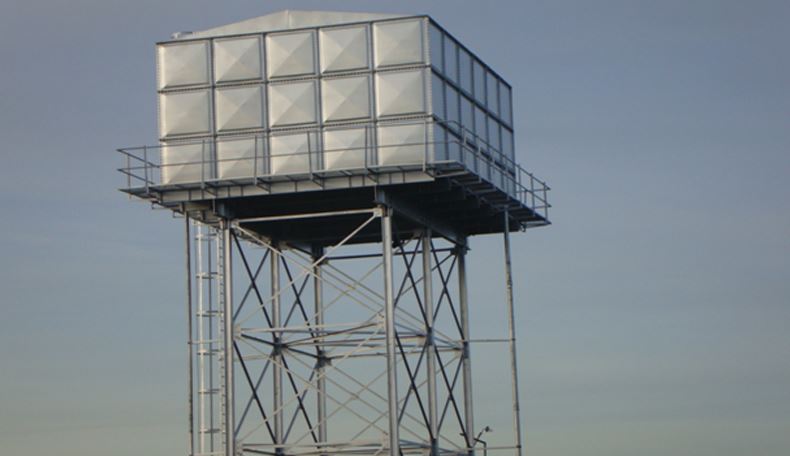
A steel water tower raises the tank above the point of use. The height creates gravity pressure, allowing water to continue flowing even when the borehole pump is not running.
Advantages of a steel water tower
- Gravity-fed pressure
- Planned borehole pump cycles
- Water availability during short power interruptions
- Good compatibility with solar pumping
- Potentially efficient use of ground space
Important tower design considerations
A tower must be structurally designed for the full tank load, wind and site conditions. Foundations are critical because thousands of litres of water create substantial permanent loading at height.
How a ground-level tank works
A ground tank stores water without lifting the full storage weight. Water may then be distributed using a booster pump or natural site elevation. Waterline Drillers also provides steel tank fabrication for larger storage needs.
Advantages of ground storage
- Easier inspection and maintenance
- Can suit large capacities
- Lower structural height
- Works with booster pumps
- Can take advantage of naturally elevated sites
Water tower vs ground tank
| Factor | Steel Water Tower | Ground Tank |
|---|---|---|
| Pressure | Gravity from elevation | Usually needs natural elevation or booster |
| Structure | Tower plus foundation | Ground support/foundation |
| Maintenance | Requires safe access at height | Generally easier at ground level |
| Power during use | Gravity can serve users after filling | Booster may need power |
| Large volume | Possible but tower structure becomes significant | Often practical for larger capacities |
| Solar use | Excellent for daytime fill and gravity use | Also suitable with proper distribution design |
How storage affects pump sizing
Storage allows the borehole pump to run according to borehole performance rather than every short demand spike. The pump fills storage at a planned rate while users draw water independently.
Why towers work well with solar
With solar pumping, water can be lifted during daylight and stored for later. In many situations, storing water is more practical than storing electricity in large batteries.
How to choose the right option
- Estimate daily consumption.
- Confirm tested borehole flow.
- Decide required pressure.
- Check site space and elevation.
- Consider grid and solar availability.
- Choose storage volume.
- Design supports for the full load.
- Plan safe maintenance access.
Fabrication should follow the water-system design
A tower or tank should not be selected only because a standard size is available. Capacity, height, structural loading, pump duty and distribution should work together.
Talk to Waterline Drillers about your borehole flow, storage capacity and site layout.
How tower height affects pressure
Gravity pressure comes from elevation. Raising the water level higher above the outlets generally increases static pressure, although friction losses and building height reduce what reaches the taps. A tower should therefore be designed from the pressure requirement, not simply from a standard height that happens to be available.
Very tall towers create additional structural demands, so the hydraulic benefit must be balanced with wind loading, foundation requirements and cost.
Tank capacity should reflect both demand and borehole yield
A large tank is useful only if the borehole can refill it within a sensible operating schedule. At the same time, a very small tank can cause frequent pump starts and leave little reserve. Storage sizing should consider daily demand, tested borehole flow, pumping hours and how much reserve the property needs.
Ground tanks often need a pressure strategy
If a ground tank is at the same elevation as the users, gravity pressure may be insufficient. The system may require a booster pump or pressure set. That adds energy use and another mechanical component, but it can still be the better choice where very large storage volumes are needed or where a tower would be visually or structurally difficult.
Maintenance should influence the decision
- Can the tank be safely cleaned and inspected?
- Can valves and pipes be reached without special equipment?
- Is there safe access to an elevated tank?
- Can the tower structure be inspected for corrosion?
- Is drainage around the tank foundation adequate?
Simple maintenance access can reduce long-term operating problems. A system that looks impressive but is difficult to inspect may be neglected.
Steel fabrication should account for the full water load
Water is heavy: every 1,000 litres represents roughly one tonne of water before adding the tank and structure. This is why elevated steelwork and foundations must be designed for the intended capacity. Increasing tank size later can significantly change the load on the tower.
Think about how the storage system will grow
Properties often add buildings, livestock or irrigation areas over time. If expansion is likely, discuss it at the design stage. It may be more economical to allow for future tank capacity, pipe connections or booster equipment from the beginning than to rebuild the storage system later.
Frequently Asked Questions
Does a water tower increase pressure?
Yes. Elevating the water creates gravity pressure, although actual pressure also depends on pipe friction and outlet elevation.
Can a solar pump fill a water tower?
Yes. Daytime solar pumping into elevated storage is a practical arrangement.
Is a ground tank always cheaper?
Not necessarily. Compare tank capacity, tower structure, booster-pump requirements and the complete distribution system.
Choose storage that works with your borehole
Waterline Drillers provides complete borehole and water solutions from survey and drilling to pumping, solarization and storage. Contact our team to discuss your site.