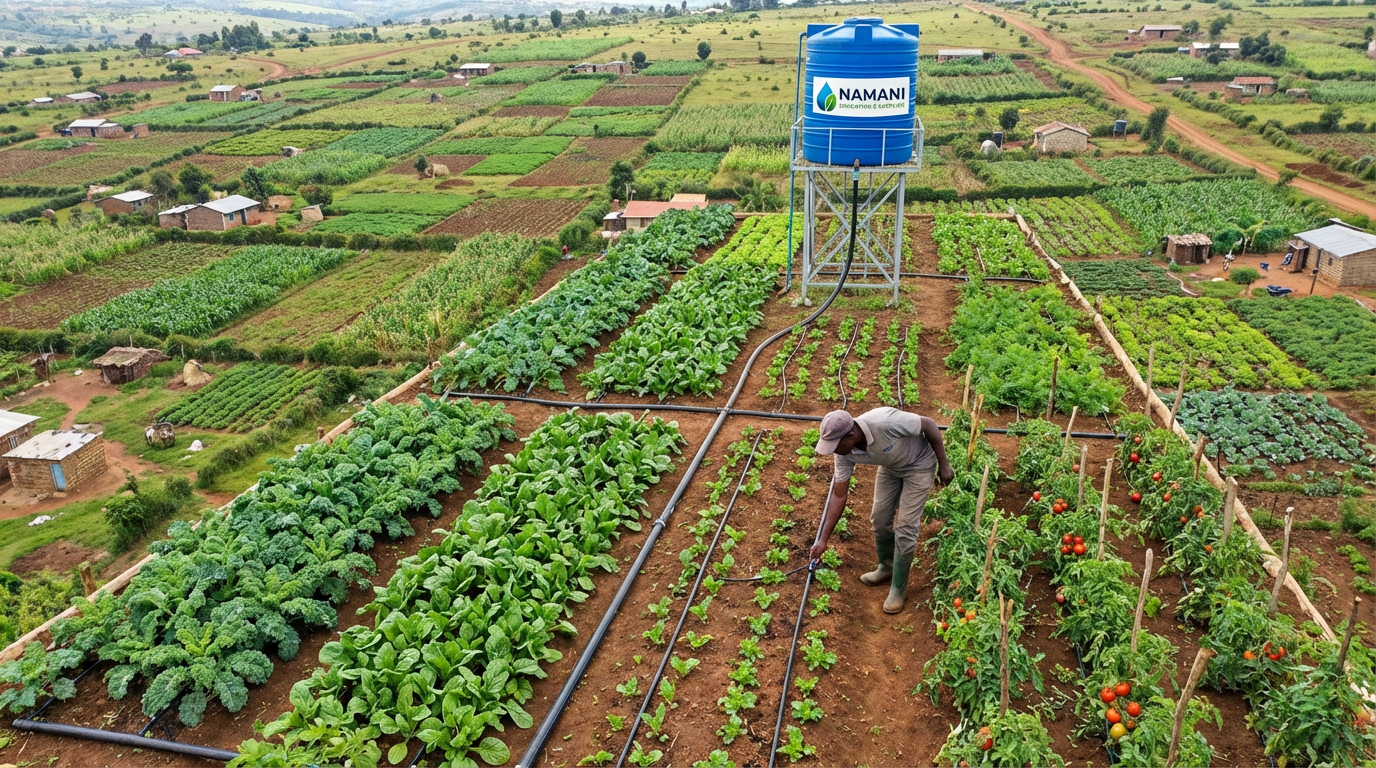
For Kenyan farmers, a borehole can provide greater control over water for irrigation, livestock and farm operations. Agricultural demand can be much higher than domestic demand, so the project should be designed around real water requirements and the tested yield of the borehole.
Calculate farm water demand first
Estimate how much water the farm needs each day. Irrigation demand depends on crop type, irrigated area, irrigation method, weather and soil conditions. Add livestock, domestic and processing demand where relevant.
Carry out a hydrogeological survey
A hydrogeological survey helps identify a suitable groundwater target and likely depth. On large farms, the drilling point should also consider distance to fields, elevation, access and future pipework.
Compare farm demand with tested yield
After drilling, test pumping determines yield, drawdown and recovery. Planned abstraction should be based on what the borehole can sustain and applicable permit conditions.
Use storage as part of irrigation design
A tank or water tower allows the borehole to fill storage gradually while irrigation draws water at the times and flow rates required. Storage also provides useful reserve during maintenance.
Solar pumping can work very well on farms
Solar borehole pumping suits many farms because strong daytime sunlight can be used to fill storage. The pump and solar array should be sized from test data, required daily volume and total head.
Choose an irrigation method that respects available water
Drip irrigation can deliver water efficiently to crop root zones. Sprinklers require suitable pressure and flow. The irrigation method changes the pumping and distribution requirements, so it should be considered before final equipment selection.
Plan pump protection and automation
Farm systems often run for long hours. Pump installation should include suitable water-level protection and controls. Float switches can stop filling when storage is full.
Keep groundwater use sustainable
WRA emphasizes sustainable groundwater development and regulated abstraction. Review current WRA permitting guidance and operate within approved conditions.
Farm borehole planning checklist
- Daily irrigation requirement
- Livestock and domestic demand
- Hydrogeological survey
- Expected drilling depth
- Tested borehole yield
- Total pumping head
- Pump flow and motor rating
- Solar or grid strategy
- Storage capacity
- Irrigation pressure
- Automation and protection
- Permit conditions
Build the whole farm water system around measured data
Start with demand and groundwater assessment, confirm actual yield through testing, then size the pump, solar array, storage and irrigation infrastructure.
Waterline Drillers can discuss complete water solutions for farms and agricultural properties.
Match crop demand to borehole capacity
Farm water planning should compare the litres required by crops with the litres the borehole can sustainably produce. If irrigation demand is higher than the borehole flow, the answer is not automatically a larger pump. A larger pump may simply draw the borehole down faster. The better solution may be longer pumping hours, more storage, improved irrigation efficiency or a smaller irrigated area.
Seasonal demand must be considered
Water demand is often highest during hot and dry periods—the same time a farm depends most heavily on its borehole. Design the system for realistic peak-season needs rather than only average annual use. If crop acreage may expand, mention that before selecting the pump, tank and solar array.
Why storage helps irrigation scheduling
Many irrigation systems need a specific flow and pressure for a shorter period, while the borehole may be best operated at a lower continuous rate. Storage separates these two requirements. The borehole fills a tank or reservoir over several hours and irrigation then draws from that stored volume at the required rate.
This approach can also make fertigation, zone control and scheduled irrigation easier to manage.
Protect the borehole from farm contamination risks
Agricultural sites may contain fertilizers, fuel, livestock waste and chemicals. Borehole-head protection, drainage and sensible separation from contamination sources are important. Water used for domestic consumption should also receive appropriate quality testing.
Plan distribution before choosing the pump
- Distance from the borehole to fields
- Elevation difference across the farm
- Number of irrigation zones
- Required sprinkler or drip pressure
- Pipe diameter and friction losses
- Tank or reservoir elevation
- Future expansion of irrigated acreage
A pump cannot be selected accurately if the distribution system is still unknown. The borehole, pump, storage and irrigation network should be treated as one hydraulic system.
Keep a reserve for maintenance and cloudy periods
Farms that depend completely on borehole water should plan a useful storage reserve. This allows essential livestock and domestic supply to continue when the pump is being serviced or when solar output is temporarily reduced. The appropriate reserve depends on the farm’s risk tolerance and daily demand.
Frequently Asked Questions
Is a borehole suitable for irrigation?
It can be if tested sustainable yield and permitted abstraction can support the irrigation demand.
Is solar pumping good for farms?
Yes, especially where daytime pumping can fill storage. The system still needs correct hydraulic and electrical sizing.
How large should my farm tank be?
Capacity depends on daily demand, borehole pumping rate, irrigation schedule and desired reserve.
Plan your farm borehole around water demand
Waterline Drillers provides complete borehole and water solutions from survey and drilling to pumping, solarization and storage. Contact our team to discuss your site.